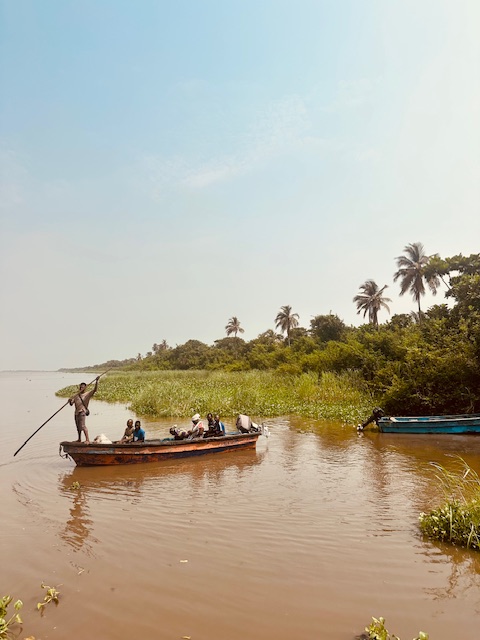
Nigeria’s coastal landscape is stunning—but its tragic past invites reflection and reverence.
It’s my first full day in Nigeria, and I’m still groggy from jet lag as we crawl through Lagos’s legendary gridlock toward Badagry—a small town with a heavy past.
Nigeria—like Libya, and unlike Tunisia—has a reputation for being one of the more challenging destinations to visit in Africa. That made the invitation from my friend Cameron Mofid all the more compelling. Cameron is a fellow traveler and the founder of Humanity Affect, a nonprofit working in Lagos. When he invited me to witness the project firsthand, I jumped at the chance.
“Life is lived in the open in Nigeria, and watching it all unfold from the van window feels uncomfortably voyeuristic.”
The road to Badagry resembles a city street more than a highway with homes and vendor stalls constructed right to the edge of the asphalt. Life in Nigeria is lived in the open, and watching it unfold from our van feels uncomfortably voyeuristic. People eat, flirt, play soccer, pray, get haircuts—even relieve themselves—in the street: the cacophony of human experience just feet from our van.

As we edge closer to Badagry, the vibrancy outside the window gives way to a more somber anticipation. This isn’t just a sightseeing trip — it’s a confrontation with one of history’s darkest legacies.
Today Badagry is a small, laid-back settlement along the coastal waterway that links Lagos, Nigeria with Cotonou, Benin. It was founded in the 18th century as one of the first European outposts in what would become Nigeria. The Europeans established their post in Badagry for one purpose: the transatlantic slave trade. Had we been here two hundred years ago, we would have found a very different town.
Our first stop is the Slave Museum, a dusty and dilapidated complex where slaves were held prior to their departure for the New World. We peek into tiny rooms, with just a small, high-set window for ventilation. There’s barely enough room for the seven of us and the idea that anyone would be kept in a room like this, let alone dozens, nearly defies belief. I enter and exit the rooms quickly. It’s physically uncomfortable to be inside, the pain of this place is palpable.
“To this day, over 100 years since his death, Chief Seriki is held in high regard by many in Badagry—a legacy I found both fascinating and troubling.”
Towards the back of the complex is a curious building, the large tomb of Chief Seriki Williams Abbas. Chief Seriki lived a fascinating life. Captured and sold as a slave at a young age, he was sent in bondage to Brazil. Remarkably he managed to become well educated and fluent in multiple languages and his slave master sent him back to present-day Nigeria in the 1830s, where he amassed power and wealth – as a slave trader. On account of his fortune and intellect he became the titular ruler of Badagry. To this day, over 100 years since his death, Chief Seriki is held in high regard by many in Badagry—a legacy I found both fascinating and troubling — a direct challenge to the way I’d always understood the Atlantic Slave Trade.

Down the road from the former slave holding complex is what is referred to as the “First Storey Building in Nigeria.” At first I wasn’t sure what was meant by the name, only to learn it was the first multistory building in the country. Erected by the British in the 1840s as one of their first toeholds in the country, it was notably the home of Samuel Ajayi Crowther, the first African Anglican bishop in West Africa. Amongst the nearly empty rooms is a glass case holding the first Yoruba language translation of the Bible. Ironically, it was here, just steps from where countless men, women and children were held in bondage, that the translation was completed.
From the First Storey building we head to the shoreline to wait for a boat to transport us across the small lagoon to the Point of No Return. It’s called the Point of No Return because enslaved Africans were taken from there to the New World—almost never to return to Africa. Tragically, these Points of No Return are common across West Africa, the former hub of the slave trade.
There’s a wait for a boat to take us across so we pass the time hanging out at a small and simple bar. There’s something incredibly incongruent about playing pool in a bar while you wait to head to a historic slave site and—not for the last time in Nigeria—I feel a great sense of unease.
Upon arriving, we walk what was a narrow path from the boat landing to the ocean beach. Now enlarged to accommodate moto-bikes and cars, it’s not hard to imagine how this landscape would have looked two centuries ago. Harder to imagine is the fear and uncertainty that must have gripped those who walked it.
Eventually we arrive at one of the most beautiful beaches I’ve encountered in my journeys. Golden-colored sand slopes dramatically toward a warm, inky sea. Tall palms sway gently in the wind. Were it not for this land’s history it would feel idyllic.

As often happens on my travels, other people begin to materialize where I thought there were none. A trio of confident and enterprising young kids appear with fresh coconuts and a machete. We buy a round—then another—and another—for less than a dollar apiece. The juice isn’t particularly cold, but it’s still refreshing. Farther down a small village beckons. Craving solitude, I walk there alone. When I arrive, I find it mostly deserted, all the doors of the small reed homes shut to the outside world. A well-kept Christian prayer area with assorted offerings is the only sign that people are still living here.

As the sun begins to set, it’s time to start the long trip back to Lagos. Our small group returns from the Point of No Return to the docks along the same path. We walk in near silence, each of us struggling to reconcile the enjoyment of the day with the heaviness of its history.
“The magnitude of the day had set me adrift, but the universality of the moment quickly anchors in place.”
At the docks we encounter a small herd of cattle on their way home for the evening. It’s a scene I’ve observed across the world, countless times. Oblivious to what happened here, the cattle graze contentedly, unbothered by the egrets that follow them. I find a surprising comfort in the scene before me. The magnitude of the day had set me adrift, but the universality of the moment quickly anchors me in place.

💌 Want to be the first to read new travel stories? Subscribe!

Leave a Reply