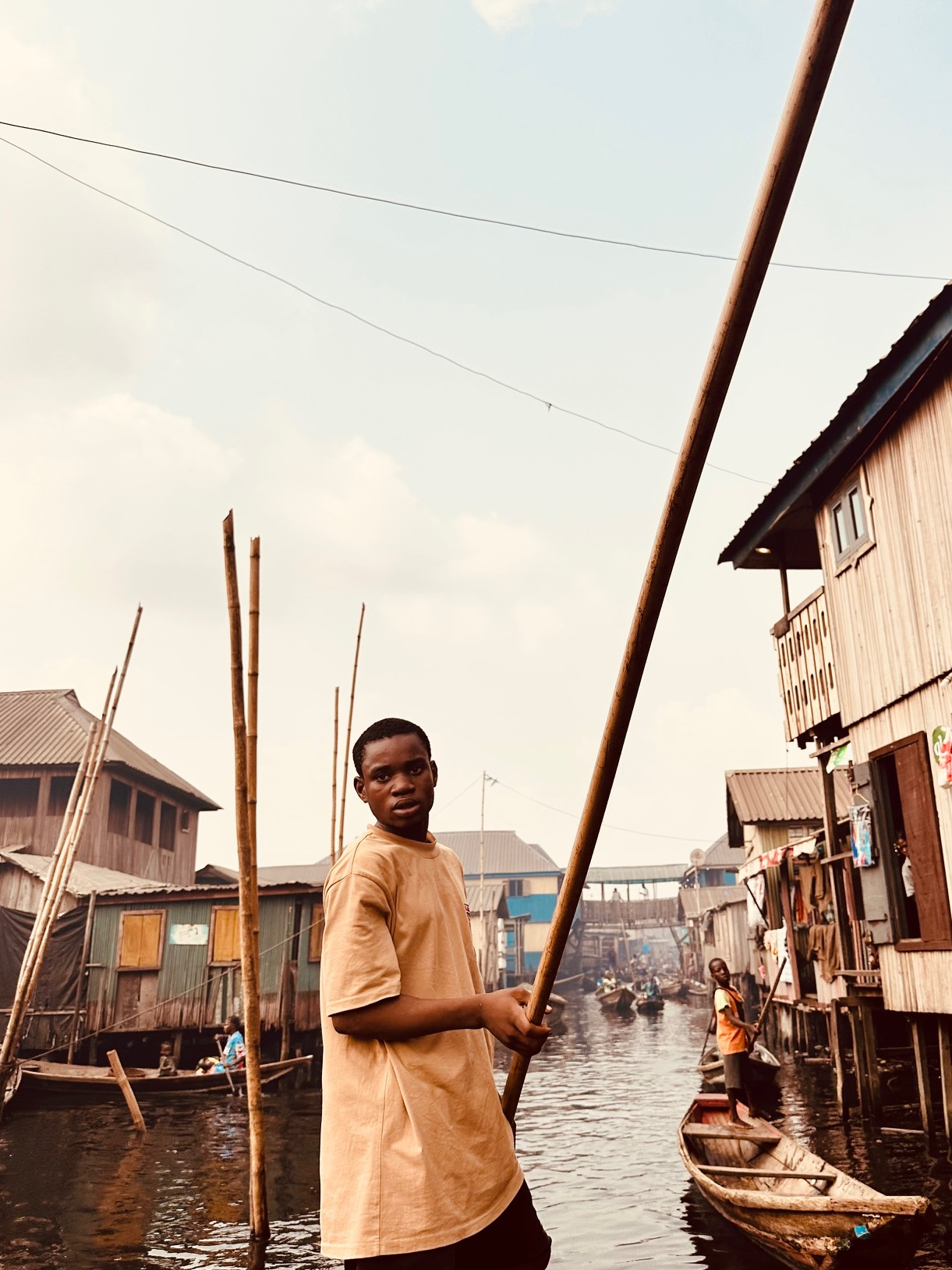
A firsthand look inside Makoko, known as the “Venice of Africa,” and how one nonprofit is supporting the community.
Like most travelers to Nigeria, I catch my first glimpse of Makoko on the drive from Murtala Muhammed International Airport to my hotel on Victoria Island. The drive follows the Third Mainland Bridge, a 12-kilometer stretch of concrete that arcs across the Lagos Lagoon, linking the mainland to the city’s coastal enclaves.
About halfway across the bridge, out on the water, a maze of mostly unpainted, wooden, low-slung homes rises on stilts. Long, narrow boats glide silently across the water, their passengers just out of focus.
“Is that Makoko?” I ask.
“Makoko,” my driver confirms, eyes fixed on the road ahead.

For most, that distant glimpse from the window of their taxi will be their first and last experience with Makoko. After all, the settlement rarely finds its way onto travel itineraries or influencers’ instagram pages. Often described as a slum — a word that, in my view, diminishes the community’s complexity — Makoko is an informal community of an estimated quarter million people built over the Lagos Lagoon. Nicknamed the “Venice of Africa” for its narrow waterways and boat-bound life, the settlement attracts a small but steady stream of travelers interested in exploring a part of Lagos that’s not often visited by outsiders.
One such traveler was Cameron Mofid, one of the youngest people to visit every country in the world. During a visit to Makoko he was so moved by what he saw — and by the people he met — that he founded Humanity Effect, a nonprofit dedicated to providing free schooling and more recently free healthcare services to Makoko’s residents.
When Cameron invited me to Nigeria to see the work Humanity Effect is doing firsthand, I was quick to say yes. I knew it would be a rare chance to experience Makoko meaningfully and would give a greater purpose to my visit to Nigeria.
Into the Floating City
A few days after my arrival, I join Cameron and a group of visitors for a half day in Makoko — a chance to see Humanity Effect’s work up close, and to meet the people at the heart of it.
“I thought coming as a guest of Humanity Effect would give my visit purpose, but I still feel like an interloper.”
The day starts early as we make our way through Lagos’ notorious traffic to the rendezvous point for the boat that will take us into Makoko. Upon exiting our van, we dive into a maze of buildings along the waterfront. With each step, the path narrows until finally only a single person can pass comfortably. People’s homes press in from both sides and I can’t help but feel like I’m trespassing. I thought coming as a guest of Humanity Effect would give my visit purpose, but I still feel like an interloper.

We climb into a small boat that will take us to one of the schools operated by Humanity Effect. After we settle in, our captain, standing tall at the stern, uses a long pole to glide us silently through the dark lagoon.
The sun is low on the horizon and the sky is hazy, lending an air of mystery to my first glimpses of Makoko. It’s still early, and while the men probably left in search of fish hours ago, the shuttered homes and surprising stillness make it seem as if the community hasn’t truly “woken up” yet. Boats full of commuters pass within inches of one another but despite the hustle and bustle it remains quiet. At least until we hear the children.
Long before we can see them, we hear them, hundreds of elementary students enthusiastically welcoming us to their neighborhood. Even at a distance their energy is infectious and as we approach the school the faces of our entire group, a mix of Humanity Effect supporters from the US and lifelong Lagos residents, begin to brighten.
We leap excitedly from our boat onto the school. Elementary schools are joyful places the world over, and this school is no exception. Children dash up and down stairs and in and out of classrooms pushing past us as they chase after one another. Like schools everywhere, it’s little more than controlled chaos — messy, loud, and alive!
After a quick tour of the school and the orphanage our group settles in to spend some time with the students. Humanity Effect has arranged for an art class for some of the kids and I’m enlisted to help. Sweating in the back of a second floor classroom, I carve sponges into stamps that the students will use to create dyed tee shirts. I’m amazed by the quiet patience of the students as they eagerly wait to get started. They listen attentively as their instructor explains the surprisingly complex process of creating their shirts. When they get the go-ahead they begin their creations tentatively but I watch their confidence grow as they continue.

A Visit to the Mainland
For our afternoon we’ve planned to take some of the students to the mainland to visit the Lekki Conservation Centre. Lagos suffers from a scarcity of green space, and the Lekki Conservation Centre exists to help fill that void. It’s most famous for its tree canopy walk, the longest in Africa, which reaches a height of over 70 feet in the air.
We’re ferried back to the mainland and then make the 90 minute drive to the Centre. For some of the kids, it’s their first time in a car!
Again there’s instructions and rules to be shared, and again the students listen patiently and attentively to everything. On the other hand I’m feeling anxious to get going, excited by the possibility of seeing one of the famously fearless monkeys up close.

Our short orientation finished, we head into the forest. Swampy and tangled with towering trees, thick vines, and dense underbrush, the park is something out of a Jurassic Park movie, although the sound of distant car horns remind us we haven’t left the city. As the path passes near the swamp our guide tells us that there are crocodiles inside; a fact that seems to pass as unremarkable for the students.
Before starting our ascent of the canopy walk, we’re divided into smaller, single file groups with an adult at the front and back of the line. We begin crossing a series of narrow metal bridges with thick wire railings that sway back and forth. Slowly we climb higher and higher via the bridges until finally we’re nearly above the tree line.
I don’t consider myself to be afraid of heights, but it’s nerve wracking to be so high off the ground, suspended in the trees, as the bridge sways.
“They’ve lived their lives suspended just a few feet above the water, moving about in small boats.”
Assuming that they must be feeling similarly, if not worse, I turn to the kids, all of whom have the same stoic smile on their face. For many of them today is the first time in their lives that they’ve walked on dry land. None of them have ever been so high off the ground. They’ve lived their lives suspended just a few feet above the water, moving about in small boats. I watch as their bodies move in synch with the swaying bridge as they take the last few steps to the top.
They move forward together with determination and without fear.

More About Humanity Effect!
As an informal settlement, Makoko receives few services from the municipal government. Humanity Effect fills critical gaps — providing a free education and free basic medical care to the residents of Makoko – essential services that every community deserves.
Beyond this important mission, what impresses me most about Humanity Effect is the way it works to broaden the horizons of its students, allowing them to imagine a wide range of future possibilities for themselves.
It also works to create connections and destroy prejudices. In Lagos, Makako is a marginalized and maligned community. By inviting residents from Greater Lagos to participate inside the community, Humanity Effect is able to change perceptions and foster greater understanding.
I’m a proud financial support of Humanity Effect and I hope you’ll consider them for your own charitable giving.
To learn more about this incredible organization please follow them on Instagram.

Want to be the first to read new travel stories? Subscribe!


Leave a Reply