A journey through Northern Nigeria‘s ancient Hausa Kingdoms is full of surprises.
I’m jolted awake as the car comes to a stop, caught in that hazy in-between where you’re not yet sure where you are. For a moment it’s the early nineties again, and I’m sprawled in the back of my parents’ Volvo station wagon, driving from our home in Minneapolis to our old home on Long Island.
We’d make the trip each summer in marathon stretches, fueled by handfuls of trail mix full of melty M&Ms and Tom Petty on cassette. The hum of the highway would rock my brother and me to sleep, waking only when we pulled off the interstate for gas or a bathroom break. Now, decades later, I’m half a world away, the same rhythm carrying me deep into northern Nigeria.
I run a hand over my head. My hair is stiff, matted with the sand and dust that cling to everything here. Outside my window is a color study in brown: ochre, sienna, umber, camel. My guide, Barry, offers me a massive bunch of carrots. They blaze orange, as if all the color in the world has been poured into them.
While we fuel up the car, I use my water bottle to rinse off the carrots and take a crunchy bite—sweet like an apple. It’s been a while since I last ate. Hours earlier, I’d started my day with a simple breakfast of pillowy white bread and milky tea in Zaria, one of the seven ancient Hausa states.
Silent Story Tellers
I’d asked Barry if we could visit Zaria on a whim, after a picture I’d seen on Instagram piqued my interest. He connected us with Sultan, a young man passionate about the traditional Hausa architecture of his hometown. After our breakfast near the Emir’s palace, we head out to find one of the community elders who has the key to a 200-year-old mud mosque.

The narrow lanes of the old city are full of people—mostly children on their way to or from Sunday Quranic school. Nearly all carry wooden tablets with verses from the Quran written on them.
We secure the key and are led back to the ancient mosque. Inside, it’s dark and dusty, but also cool and calming. A modern prayer mat sits atop an animal skin of unknown origin; a clock rests on a chalkboard where the day’s prayer times have been written. The thick mud walls shut out the rest of the world. Outside the doorway, a water pump is a hive of activity. Around the world, I’m always struck by how sharply the threshold of a religious building separates the sacred from the profane.

As we continue touring the city, I take the opportunity to talk more with Sultan. I ask him what attracts him to this part of Zaria.
“Without these buildings, we wouldn’t have anything tangible to show the rest of the world about our long history, culture, and civilization,” he says. “They are the silent storytellers of who we are. Every design, motif, and wall carries the wisdom and artistry of generations before us.”

Some of the buildings we view from the outside, while others we have the opportunity to enter. We wait often, passing time in casual talk or silently watching the world pass by. I enjoy seeing Sultan and Barry’s demeanor shift whenever an elder arrives with a key: from jovial to reverent in the blink of an eye.
Eventually, we make our way back to the car and say goodbye to Sultan before heading back to Kano. As we leave Zaria behind, I’m thankful to have spent time in a city few Western tourists get to see—and in a way even fewer get to experience. Just outside the city the road opens up, our driver hits the gas, and turns up the Hausa-language music he’s playing. The rhythm of the music and the road quickly lull me to sleep.
Stories of Serpents
The next morning, we pass through a dramatically different landscape on our way north toward Daura. Browns give way to greens—for Hausaland, the scene outside feels lush. The journey is slow, punctuated by frequent document checks. This close to the Niger border, uniformed officers are a constant presence. While time-consuming, each stop is brief, polite, even friendly.

Upon arriving in Daura, one thing stands out immediately: snakes. Coiled among fence posts, slithering across signboards, curling in bright paint along the walls. Some are lifelike, others more stylized, all staring back at me with unblinking eyes. I ask Barry their significance.
“You’ll see,” he says.
The answer comes at our first stop: the Kusuga Well.
The well is housed in a small building protected by a metal fence decorated with serpents coiled around a sword. Per our usual routine we wait around a bit for someone to come with the key, passing the time chatting with a few locals who appear out of nowhere.
Once inside, it takes a moment for my eyes to adjust. The room is empty save for a few plastic chairs along the walls and a well at the center. It doesn’t look like much, but tens of millions of Hausa people today trace their origins here.
According to legend, centuries ago a traveling Baghdadi prince named Bayajidda arrived in Daura and asked an old woman for water. She told him there was none, because a snake guarded the town’s only well, allowing residents to draw water only once a week.
Bayajidda, seeing an opportunity, went to the well and killed the serpent. The people of Daura were overjoyed. Now they could get water whenever they wanted. The Queen of Daura offered Bayajidda half of her kingdom in gratitude, but he countered by asking for her hand in marriage instead.
From here, as can happen with a 1,200-year-old story, things get muddled, but a popular version is that Bayajidda and Queen Daura had a son, Bawo. Bawo had seven sons, who went on to found the seven Hausa states of Biram, Daura, Kano, Katsina, Rano, and Zaria. In this way Bayajidda and Queen Daura are remembered as the founders of the Hausa people.

From the well we visit the Emir’s palace, a small, quiet compound covered in a cacophony of colors and yet more images of snakes. The palace is guarded by the Dogarai, traditional custodians of Hausa culture. A friendly Dogari in ceremonial dress graciously poses for a photo while we wait to sign the official guest book. As I sign, I notice I’m the first Westerner to do so in months—a reminder of just how far from the usual tourist trail Daura lies.
Our visit is brief — just a glimpse into the birthplace of a people — before we’re back on the road. The long drive to Kano lies ahead.

The Heart of Hausaland
No trip to Kano is complete without a visit to Dala Hill, the city’s physical and spiritual center.
It’s still dark when Barry picks me up from my hotel. Sleepy, I jump in the back seat and our driver takes off through the narrow streets toward the hill.
At the base, an elderly man is waiting for us; Barry’s arranged for him to explain the site’s significance.
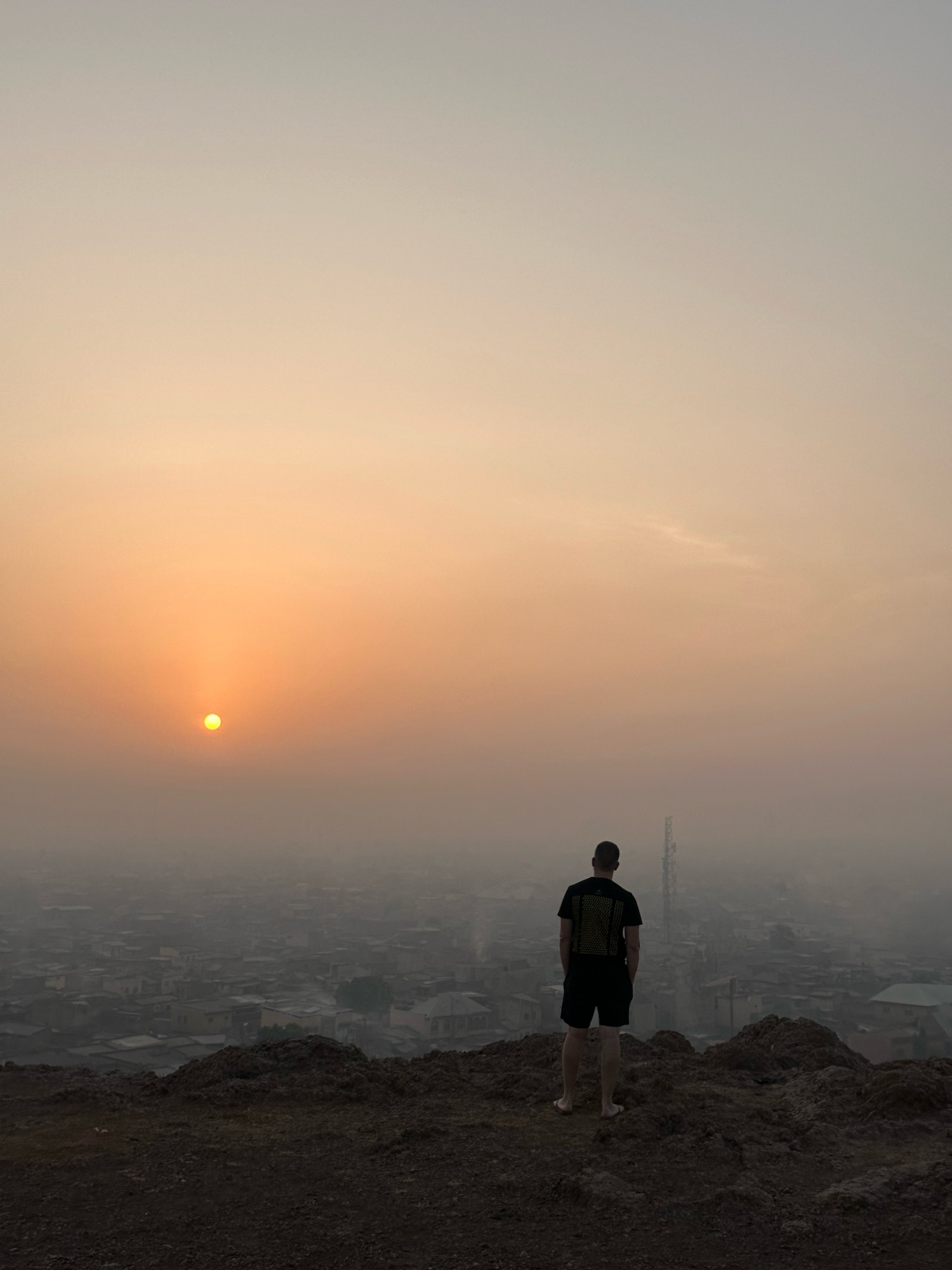
The walk is easy. Dala Hill isn’t really a hill at all but a massive rock, the city spilling outward from its base. Below us, Nigeria’s second-largest city stirs awake—roosters crow, and beyond the smokey haze rooftops stretch to the horizon. While I admire the view, our guide shares the history.
In pre-Islamic times, the people here worshipped a deity named Tsumburbura, he tells us. Their chief priest, Barbushe, foretold the coming of Islam to Kano:
“A man shall come to this land with an army. He will gain mastery over us. You will see him in the sacred place of Tsumburbura. He will conquer this country and exalt himself and his people for years to come.”
That man was Bagauda, grandson of Bayajidda and Queen Daura. He arrived in Kano in the 11th century, waged war against the pagans, and established the Islamic Emirate of Kano that survives to this day.
Back down the hill our next stop is the Emir’s palace, the third and largest palace I’ve visited in northern Nigeria. We’re led through a series of rooms that grow increasingly lavish until we reach the throne room. Nearly every surface in the palace is crowded with Hausa symbols, chandeliers, and plush carpets. My favorite, is also the most elaborate, a room first built for Queen Elizabeth’s visit in 1956. Our host insists I pose for pictures in the oversized “Chinese-made” chairs and next to a gilded floor lamp that wouldn’t look out of place in the aisles of HomeGoods.

With my flight departure looming, we race to what I’ve most been looking forward to: Kano’s indigo dye pits.
For over 500 years indigo has been used to dye cloth in Kano. The occupation, passed down through families, is sadly ending as younger people can no longer make a living from it. I wanted to see the process for myself, and I’m quickly mesmerized by the sight of men dipping yards of cotton into vats of bubbling, midnight-blue dye.
The dyeing is men’s work, but it’s the women who prepare the cloth. We walk a few hundred meters to meet one woman who has spent her life in this work. We chat briefly as her hands move expertly across the cloth. She gives me an opportunity to try and predictably, my attempt elicits laughter in everyone – myself included.

Back at the pits, I feign disinterest as I’m offered various fabrics. Everyone knows I’m not leaving without buying, so it’s only a matter of time before I purchase two large pieces of expertly dyed cloth. A tangible connection to an ancient art.

Our final stop is Kano’s main market. I’m searching for a Zanna cap, the traditional men’s headwear of this region. After over 90 countries, I’ve seen countless markets, but Kano’s stands out. It’s not full of the usual cheap, imported plastic items you see everywhere. People still make things here. I regret not leaving more time to explore, as we rush through the narrow lanes. Eventually I find a shop that looks promising, and after too much deliberation I buy one. The shopkeeper sews a traditional pom-pom on top. Wearing it, I look slightly silly but incredibly happy.

Soon it’s time to rush to the airport for my flight to Jeddah. Historically this city has been a departure point for Muslims from across West Africa making the pilgrimage to Mecca. In the past they’d make the trip across the Sahara on camel, or even on foot. Today I’ll be flying in comfort on a Boeing 777.
Shortly after takeoff, as we fly toward Saudi Arabia, I’m fast asleep. My Zanna cap proudly atop my head, I dream of my return to Kano.
Planning a trip to Northern Nigeria? Use the below map to help plan your trip!
Never miss a new story – Subscribe!


Leave a Reply to freelycd7a2c30b7Cancel reply